


Childhood Under Occupation: Militarization in Transnistria's Education System

In Europe’s eastern periphery, beyond the checkpoints and Soviet monuments of Transnistria, another kind of battle is unfolding: not one fought on front lines by armed adults, but one taking shape in classrooms, youth camps, and spaces meant for education and play.
For nearly three decades, the territory temporarily occupied by Russia along Moldova’s eastern border has existed under the effective control of Russia-backed authorities. While the conflict itself, a long-running standoff between pro-Russian forces in Transnistria and the Moldovan government, is often described as “frozen,” the ideological shaping of younger generations has been anything but static. According to human rights advocates, children in Transnistria are being raised in an environment where militarization, Soviet nostalgia, and pro-Russian narratives are embedded into everyday education.
To better understand this phenomenon, I spoke with Mihaela Șerpi, a human rights expert at Promo-LEX, an organization that has documented abuses in the region for years despite being banned by the de facto authorities in Tiraspol. Her work focuses on political rights, propaganda, unlawful detention, and increasingly, the indoctrination and militarization of children in the occupied region.
“The education system became a tool of political and ideological control almost immediately after the 1992 war,” Șerpi explains.
“A whole generation has now grown up under this system.”
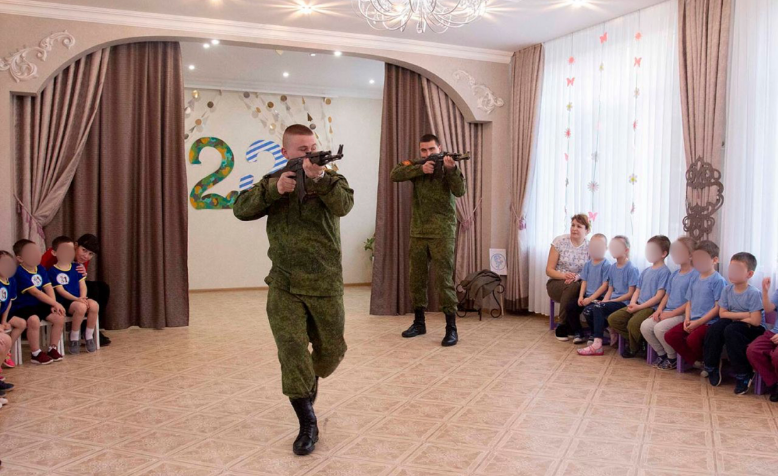
Cadets from the "Suvorov Military School" in Tiraspol performing techniques with a Kalashnikov rifle at kindergarten No. 19 in Tiraspol
Source: "Suvorov Military School in Tiraspol", 2019
According to Promo-LEX’s findings, which are based on remote monitoring, testimonies, and the analysis of official materials and legislation, approximately 77,000 children and young people are currently educated within the Transnistrian system. Since 2002, schools in the region have adopted Russian educational standards, while local legislation has been progressively aligned with that of the Russian Federation. Promo-LEX argues that this educational environment increasingly embeds militarization and pro-Russian narratives into the socialization of younger generations.
The consequences, Șerpi argues, extend far beyond curriculum changes. Children in the region learn little about Moldovan history or culture, while Romanian-language education has been systematically marginalized. Romanian written in the Latin alphabet has effectively been banned since 1994, making Transnistria the only place where Romanian continues to be taught in Cyrillic script.
At the same time, patriotic and military-themed activities have proliferated. In just the first half of 2025, nearly 1,000 “patriotic events” involving over 136,000 participants, mostly children and young people, were organized in the region. These events frequently promote narratives portraying Moldova as an aggressor and Russia as a historical protector.
More strikingly, military training has become normalized in educational life. According to Promo-LEX, over 700 children between the ages of 10 and 17 attend annual military camps, while more than 25 schools operate under the patronage of Transnistria’s so-called “Ministry of State Security,” an institution widely regarded as the successor to the Soviet KGB.
Children can also enroll in paramilitary institutions such as the Cadet School in Bender or the Suvorov Military School in Tiraspol. Since their establishment, around 600 minors have graduated from these schools, which train children as future members of security and military structures.
“In practice, these children are deprived of their childhood,” Șerpi says.
“They live under conditions similar to military units and are subjected to army-style discipline from a very young age.”

Children from kindergartens in Bender participate in the march of great-grandchildren "Greetings to great-grandfather!"
Source: Novosti pridnestrovie, 2024
The militarization extends into extracurricular life as well. Children participate in clubs linked to movements such as Yunarmia, a Russian youth military organization, where activities include weapon assembling, throwing grenades, piloting drones, and simulating combat. Some instructors are former combatants from the 1992 Moldovan-Russian war or veterans of Russia’s war against Ukraine.
One of the most controversial dimensions of this system involves so-called educational camps in occupied Crimea and the Russian Federation. Over the past nine years, more than 100 children from Transnistria have reportedly participated in these programs.
Among them is the infamous Artek children’s center in occupied Crimea. Once a prestigious Soviet summer camp, Artek has, according to Ukrainian authorities and international observers, become part of Russia’s broader project of ideological “re-education” in occupied territories.
Șerpi notes that children from Transnistria are often selected through competitions centered on Soviet history, the Second World War, and narratives glorifying Russian military power. Winners receive vouchers to attend camps in Crimea or Russia.
For human rights organizations, these practices raise profound concerns.
“These activities normalize war and reshape children’s identities,” Șerpi warns.
“Children in Transnistria often end up knowing more about Russia than about the country where they were born.”

Children from a kindergarten in Bender pose next to a truck-shaped decoration inscribed with the message "To Berlin!"
Source: Transnistria News Feed, 2025
Promo-LEX has documented cases where orphaned children as young as three or four participated in games titled “Minefield” or “Carry the Ammunition,” activities that imitate warfare and normalize violence.
The implications are not merely cultural or political, but also legal. International human rights standards, including the United Nations Convention on the Rights of the Child, prohibit militarized education and emphasize the child’s right to an education free from indoctrination. Both Moldova and Russia have ratified this convention, making them legally obliged to adhere to its principles. In 2014, the UN Committee on the Rights of the Child specifically urged Russia to prohibit military training involving children and end the application of military discipline standards in schools.
Yet accountability remains elusive. Moldova lacks effective control over the territory, and international monitoring inside the region is nearly impossible.
“The population has no effective protection mechanisms,” Șerpi explains.
“There is no independent judiciary, no real possibility to report abuses, and no functioning system of accountability.”
Still, she insists that documenting these realities is essential, not only for raising awareness, but for preparing for a future reintegration process that Moldova has scarcely begun to address. As Russia’s war in neighboring Ukraine has renewed attention on unresolved post-Soviet conflicts, questions about what reintegration would mean socially and politically, not just territorially, have become increasingly difficult to ignore.
“Reintegration will not simply mean restoring administrative control,” she says. “It will require a long-term process of demilitarization, democratization, and rebuilding trust through education.”

Source: Novosti pridnestrovie, 2024
According to Șerpi, Moldova must already begin developing policies for transitional justice, educational reform, and psychological reintegration. After more than thirty years of occupation, the effects of militarized education will not disappear overnight.
The challenge, she argues, extends beyond Moldova itself. The situation in Transnistria reflects broader geopolitical tensions between Russia, Ukraine, and the European Union, and demonstrates how education can become a strategic instrument of influence in contested territories.
“This is not just about schools,” Șerpi concludes.
“It is about shaping loyalties, identities, and the future political orientation of an entire generation.”


Comments