


Fragments of Cleopatra

December 2025 found me at the Arab World Institute in Paris, beholding the Mystery of Cleopatra, running from June 2025 to January 2026.
The exhibition was quite lengthy, beginning with a series of artifacts related to Egyptian mythology and historical foundations, an enumeration that appeared endless to me. Nonetheless, with the world of Cleopatra open to me, I encountered numerous fragments of her that have shaped the Cleopatra of the common psyché. Through several lenses, people have constructed the phantasm of Cleopatra, arousing both ardor and dread. Before my eyes, numerous chapters unfold, and for each fragment, a distinct Cleopatra comes forth.
Fragments of a Rule
A chronology could be observed from above on a wall, austere and relentless, mapping with precision most of the events that marked Cleopatra's path. I have transcribed it for you below word-for-word:
69 BC
Birth in Alexandria of Cleopatra VII.
52 BC
Cleopatra VII is named co-ruler by Ptolemy XII, the start of her royal era.
51 BC
Death of Ptolemy XII.
49 BC
Egyptian civil war between Cleopatra and her brother-husband, Ptolemy XIII.
48 BC
Caesar lands in Alexandria. Caesar and Cleopatra become lovers.
47 BC
Death of Ptolemy XIII. Caesar restores Cleopatra to the throne.
Cruise of Cleopatra and Caesar on the Nile.
Birth of Ptolemy XV Caesar, called Caesarion, son of Cleopatra and Caesar.
46 BC
Cleopatra joins Caesar in Rome.
44 BC
Caesar assassinated in Rome.
41 BC
Cleopatra meets Mark Antony in Cilicia (today’s Türkiye). They become lovers.
40 BC
Mark Antony leaves Cleopatra and marries Octavian’s sister, Octavia.
37 BC
Cleopatra reunites with Mark Antony in Syria.
34 BC
Octavian accuses Mark Antony of treachery under the guilty influence of Cleopatra.
30 BC
Suicide of Antony and Cleopatra in Alexandria. Octavian has Caesarion executed.
Fragments on Paper
As words can condemn a name,
Some authors summon forth shame,
She must take the blame,
And stands above rumor and shame,
As her calm regard conquers that game.
The words that an author puts down on paper can claim to permeate the collective psyché for years. Words mould and insinuate.
I approach these fragments with an almost intimate vigilance. To judge her with ink is to exercise power over her, and it must be said that this power was corrective and often unforgiving.

‘...when on the Capitol an impious foreigner brought vengeance, and death, and fires.’
Horace, in his Ode XVII, does not pronounce her name without condemning her. She is impious, a foreigner. She is a political threat, embodying an Eastern danger ready to devour Rome.

‘The Queen of Egypt, his wife – oh, shame!’
‘The Queen in the midst of her fleet (...) does not see the two snakes waiting for her on her return.’
Virgil continues, but this time the shame takes on a deeper and more intimate dimension; it is not the political alliance that is shameful, but the union itself. It stains Roman dignity, undermining the symbolic architecture of Roman virtue.

‘All is lost; this false soul of Egypt hath betrayed me... Triple-turned whore!’
‘Betray'd I am. O this false soul of Egypt!’
Shakespeare later revisits this accusation in Antony and Cleopatra. Cleopatra is never just a strategist; she is the cause of Rome's misfortunes. Her political power is redefined as a corrosive seduction, her diplomatic skills reframed as moral subversion. With extremely lewd vocabulary. Shakespeare nevertheless gives Cleopatra some power; even when insulted, she remains central, and this condemnation in Shakespeare's work can be seen as a reluctant reverence.

‘The queen listens, with cold insolence, to the troubled murmurs; her eyes question her suitors.’
‘The proud queen walks towards her victims.’
While Shakespeare seems to attempt to restore her importance in his work, Pushkin's Egyptian Nights offers a new perspective where Cleopatra is the undisputed sovereign of the scene. While the male gaze seems troubled and faltering, hers remains glacial and sovereign, operating from a position of calculated authority.
These texts all have one thing in common: they are unable to separate Cleopatra from her body. Cleopatra's Egyptian diplomacy is her charm; the alliance is seduction and, even more than that, the alliance is marriage and, therefore, treason, collapsing statecraft into intimacy.
Through them, it is like an ancient concern, a woman who no longer merely influences but commands.
These fragments of literature presented to me brought me closer to Cleopatra, this strategist who speaks several languages, who negotiates, and who understands the political tensions of the Mediterranean. In a realm where adulterous women must be burnt and their ashes scattered. Female seduction is a sin. A woman's influence is de facto deviant. Cleopatra concentrates these anxieties by being the female essence onto whom Rome projects its own fragilities.
Each author attempts to capture her, and yet none of them possesses her. When I read these pages, it is as if they were not condemnations but almost confessions: Horace confesses fear, Vigilius scandal, Shakespeare fascination, and Pushkin turmoil. Cleopatra passes through these pages without dissolving; she is the one who is accused, desired, and feared, yet never contained.
Fragments on Canvas
Soft brushes want to uncover her royal core,
The stroke covers truth, but none explores,
Colors should have attempted to show more.
After the words on her, her flesh represented. Countless works are featured in this exhibition, but the common thread linking most of them is her death. Almost all converge on Cleopatra's death, a moment of political closure. It is this moment that has been depicted most often. In these paintings, Cleopatra is no longer a strategist; she is a dying woman. This theatrical scene, which is the ultimate act of control over her destiny, is transformed into a tableau of sanctified surrender.
Her end is acceptable and noble; the snake bite is the surrender of a sovereign who no longer poses a threat. She no longer disturbs the imperial order; Cleopatra had to be defeated for Rome to triumph.
To delve deeper into Cleopatra’s appearance, we do not know a lot about Cleopatra's mother. Her father, Ptolemy XII, belonged to the Greek Lagid dynasty, but alas, her maternal lineage remains unknown, and it is this uncertainty that creates a void that painters have filled.
While Cleopatra's maternal side remains uncertain, we do know that she never possessed an opalescent pallor. And yet, you’ll see below two works where Cleopatra appears with translucent skin and blonde hair, in keeping with the aesthetic standards of another era.
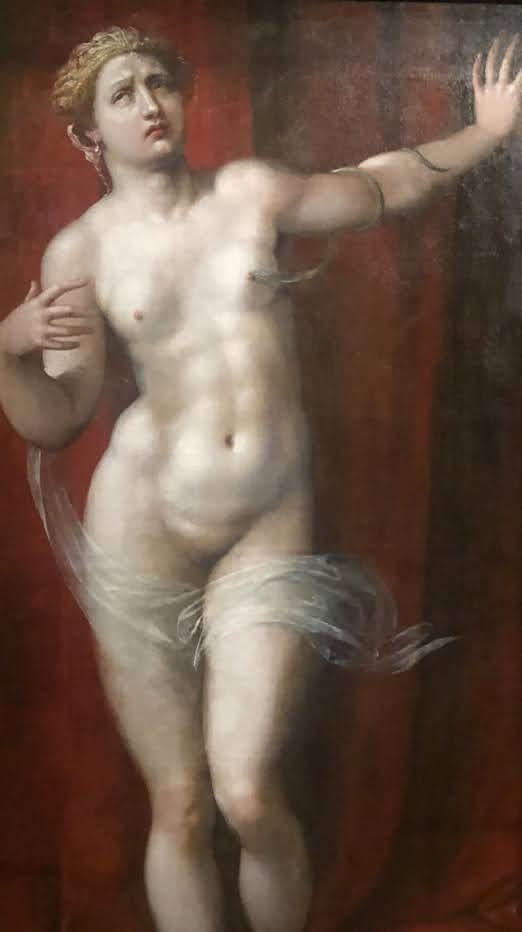

A revealing choice that allows us to understand that Renaissance Europe was not contemplating ancient Egypt but rather contemplating its own reflection. By projecting its standards of grace, the descendant of the ruling dynasties of the Mediterranean became a body whose contours were adjusted to the era in order to be better absorbed. This error is not cultural; her pearly skin is an admission even on canvas. Cleopatra is fragmented, always looked at, represented, and yet rarely left intact. Cleopatra continues to be subdued by the gaze.
Fragments on Stage
The stage as her throne,
Gestures echo a measured tone,
No other actor dares her presence alone.
One striking feature of the exhibition is a document containing an interview with Mounira al-Mahdiyya conducted in Cairo, Egypt, in 1950 by Amani Nasheed.
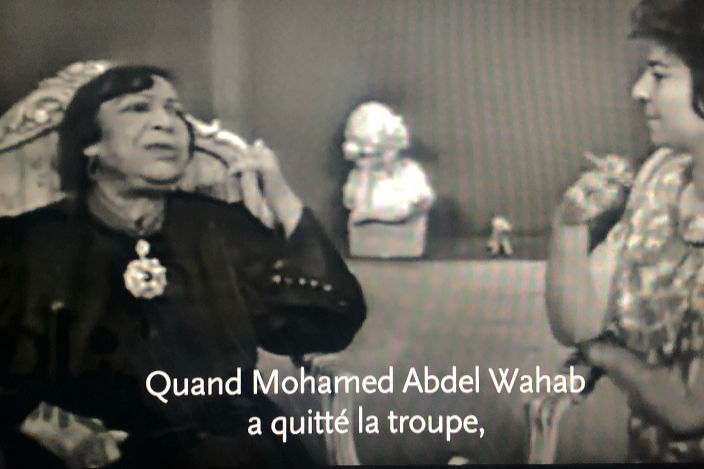
“When Mohamed Abdel Wahab departed from the troupe”
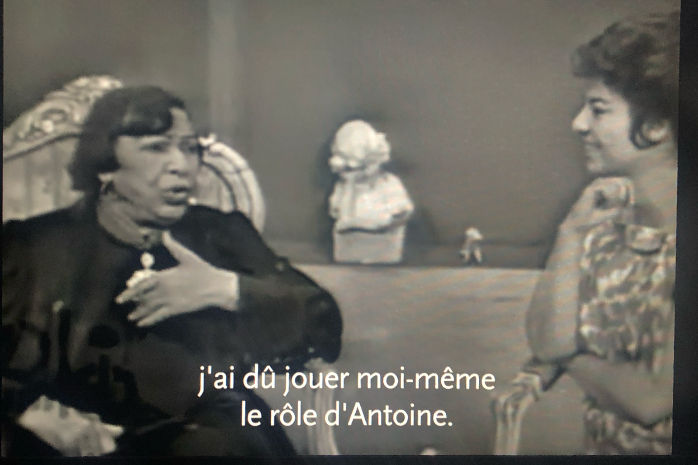
“I had to play the role of Antony myself."

“Yet the Egyptian and foreign journalists were displeased."
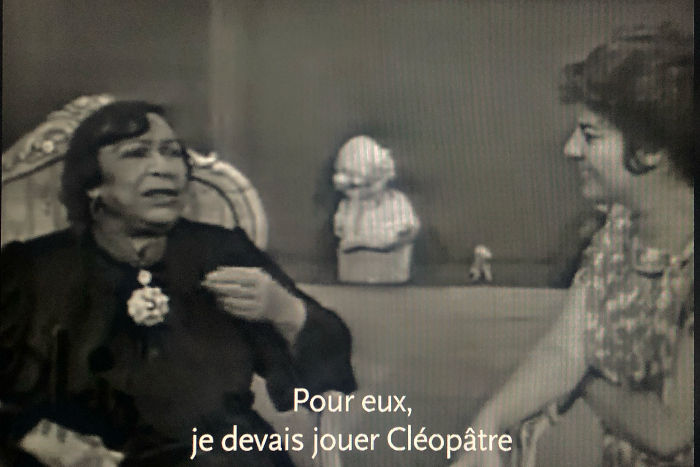
“For them, I was to play Cleopatra."

“And find any man whatsoever to play Antony."
Mounira al-Mahdiyya, a great figure of Arab musical theatre, talks about her relationship with Cleopatra. For an opera, she had to play Cleopatra, no matter who played Antony; they would find any other man. But she cannot be replaced, that much is clear. Mounira will be Cleopatra. In the play, Cleopatra is the central figure, while the Romans are merely shadows revolving around her. The roles of the Romans can be redistributed, but the focus remains on the female character.
Where words make her a dangerous woman, theatre places her at the heart of the drama; she is not a shadow; she is a pivot of gravity. Mounira's words resonate, proving that Cleopatra is no longer just a legend but a reclaimed sovereign presence in Arab culture.
Fragments on Screen
Each frame reveals what has never been seen,
As her shadows flows through realms unseen,
None surpasses her, the eternal queen.
In keeping with the desire to counter the Roman view of Cleopatra, a film embraces the greatness of the Egyptian strategist and brings her glory: Joseph L. Mankiewicz's Cleopatra from 1963. One of the most ambitious films ever made, with a running time of six hours before being cut and a colossal budget. The most expensive film in cinema history. The exhibition at the Arab World Institute covers numerous representations of Cleopatra and shows a few excerpts, but to focus on other appearances would be an insult to this work, which will thus monopolize this section on its own.

A dimension that goes beyond the financial cost and truly embodies the legend of Cleopatra. An excess that can be felt in the sets with their monumental, sculpted columns, the costumes, the actors, and the length of the film. All of this is a means of conveying Cleopatra's domination and hold over her world; each shot seems designed to expand the space around her as she steps off her vessel, escorted by a procession of women reminiscent of a loyal and devoted army.
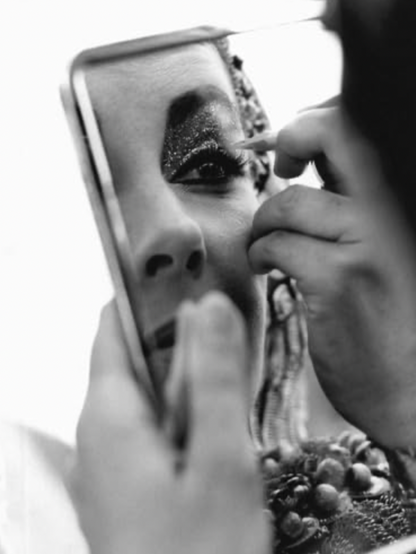
The make-up itself could be solely studied by scholars as a political territory where Cleopatra's black eyes are outlined with excessive eyeliner, her eyelids emphasised. Her gaze as a weapon, each movement of her eyes a calibrated declaration. Even in Cleopatra's intimate moments, this make-up confers a certain authority, as if she were holding Caesar and Antony within the quiet architecture of her will.

Returning to memorable scenes, her entrance into Rome will remain in the common psyché. The streets are reconstructed in her wake with the grandeur of the ancient ruins themselves. With countless extras, the entrance of a foreign sovereign into Rome rivals Rome itself. As Roman conspiracies tighten, Cleopatra grows stronger, like the columns that grow taller and taller, an axis around which Rome itself seems to tremble.

This film allows Cleopatra to take centre stage, more than she has ever been portrayed before, with the Romans, alliances and betrayals all revolving around her. She commands the space; she is no longer just flesh on canvas or a monster on pages. She stands before you, a woman of substance.
Marble Fragments
Cold stone could guard her form,
Her grace becomes the norm,
The Death draws near but cannot deform,
As the last command alone shall perform,
Never can a Roman hand make her conform.
The need to conclude with Cleopatra encapsulated in marble. After all these fragments, there were two sculptures that I had the chance to observe. The folds of the drapery, the twists of the body, and the marble that makes tangible the sovereign who decides her own end, presiding over her death as over a final decree.
As with the paintings, the sculptures represent Cleopatra's death. Proof that of all the moments we remember about her, her end was the most eloquent and the most reproduced.
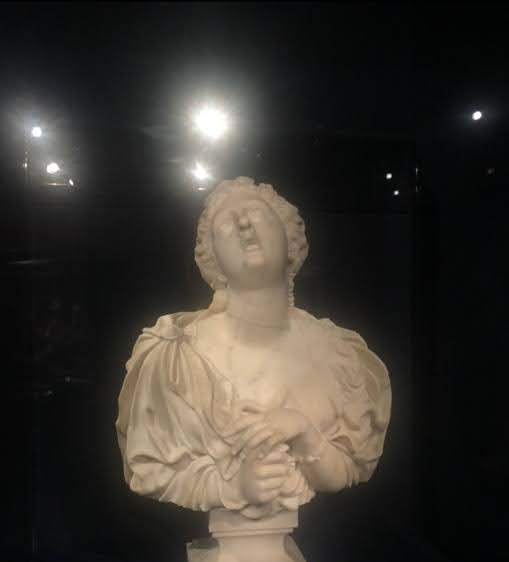
Claude Bertin's sculpture depicts a draped Cleopatra whose body blends into her sheets, death tenderly embracing Cleopatra, the nuance of the gesture contrasting with the intensity contained in her facial expression. Detached from projected allure, she appears pure and immutable. I remain silent in front of this sculpture.

On the other hand, this work, attributed to Jean Baptiste Goyn, depicts a dying Cleopatra, standing upright, not collapsing. The twist of her body and her gaze turned towards the ground embody mastery even in her fatal gesture. Here, her suicide is not synonymous with submission; she is still sovereign. The marble captures both her fragility and her power. The marble is both witness and accomplice to her decision.
Beyond the marble, it is the gesture that captivates me. In fact, Cleopatra never truly dies; she remains the sovereign guardian of her power. I am no longer just a visitor to the Arab World Institute; I am a witness to the eternity of Cleopatra, consecrated in stone.
As you browse through all these fragments, I hope you get a coherent assessment of the numerous representations of Cleopatra, not as contradictions but as successive negotiations of her relevance. Her refusal to dissolve remains; she is not just remembered; she is strategically reassembled. So Cleopatra is never fully resolved, a construct that remains beyond reach.
All museum photos were taken by Eleonore Dlugosz Donnen at the Arabic World Institute in December of 2025.


Comments