


If You Read One Thing Today, Let It Be This: Sudan.
“I still think about our revolution in 2018 when all Sudanese people were on the streets, united against Omar al-Bashir. The most beautiful was the sit-in on April 6, 2019, outside the General Command headquarters. We were all in the square. I remember people saying this was the future of Sudan.”
— Musa, age 40, from Khartoum
We are living in a day and age where some are granted the privilege to remain ignorant, while others suffer daily. If you belong to the former category–the party of the privileged–I urge you to read this article with purpose and empathy. When you read words like ‘death’, ‘war’, or ‘famine’, do not allow your mind to read past this without a second thought.
Pause. Take your time. Digest this. And read with full intention.
As a society, we have become utterly desensitized to the stories and horrors around us, so much so that we read about suffering and view images of people in pain, but feel a complete indifference towards it. Please, not only when reading this but for every future piece you examine, try your best to be attentive, curious, sensitive, and aware.
The following editorial is not an attack on you, nor is it an attempt to evoke feelings of guilt. Conversely, it is written in the hope that you will learn something and that you will pass on this knowledge to others. More than that, it is an effort to showcase personal narratives from individuals in Sudan and to inspire a global interconnectedness.
To help encourage this awareness and foster more knowledge, I will give you some context about the history and grounds for which the Sudan war of 2023 began, as well as some insights into what you – as a person living in an entirely different place, both physically and metaphorically – can do to help. Towards the end of the article, I will provide you with some facts about what people and organizations are actively doing about the war.
However, before getting into it, I would like to point out that there is an incredible amount of history embedded in Sudan, most of which I am not equipped enough myself to present a thorough analysis of. However, I will do my best to pass on the knowledge I have obtained from various information nights, documentaries, and online research, and hope that this may lead you to further research yourself.
With that being said, let’s begin.
North vs South, The Great Divide
Sudan was primarily colonized by the United Kingdom, no surprise there, and Egypt under the Anglo-Egyptian Condominium from 1899 to 1956. It is important to remember that the laws and power dynamics under colonization in Sudan, like most colonized countries, serve as a distinct domino effect, influencing the chain of events for every moment thereafter. In this case, colonization played a defining role in the split of the country in 2011. This is because the Anglo-Egyptian policies that were implemented favored the Arab-Muslim North of Sudan, prioritizing their infrastructure and education, while neglecting the African South and leaving their education to the Christian missionaries. The British authorities enforced this divide because they believed that the South “was not ready to open up to the modern world”. This undeniable racism is particularly significant to bear in mind when examining the reasons for future disputes between the North and South of Sudan.
For instance, after Sudan gained its independence on January 1st, 1956, the country faced immediate internal instability and conflict due to the sharp divide between the two regions. The Northern region, which was majority Arab or Muslim, held greater political power, while the Southern region, which was largely Christian or animist, was economically and politically marginalized.
This sharp divide sparked two civil wars – the first between 1955 and 1972, and the second between 1983 and 2005. The wars were fought predominantly between the Khartoum central government, located in the Northern region, and the southern separatist movements. These hostilities resulted in severe suffering with widespread famine and atrocities, resulting in the death of around two million people.
Read that once more. Two million people. You would need to fill about 20 to 25 full stadiums that seat 100,000 people to reach two million. There was so much suffering and pain, all derived from the colonial history that preceded it.
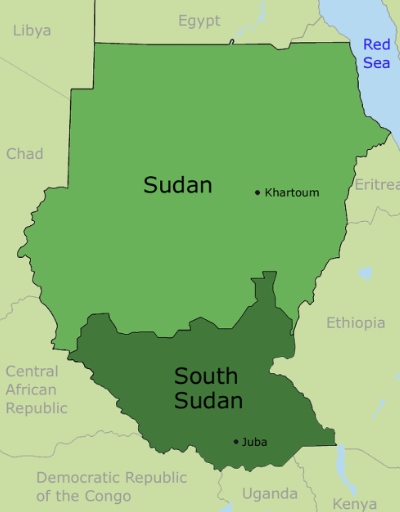
In 2005, a Comprehensive Peace Agreement was signed by the National Congress Party (the government of Sudan) and the Sudan People’s Liberation Movement (the movement of the Southern Sudan group). This agreement ended the second Sudanese Civil War and set forth a six-year interim period, whereby both government structures would coincide with one another.
Moreover, this agreement included the Southern Sudan self-determination right, ultimately leading to the formation of the Republic of Sudan in July 2011, after an overwhelming majority of participants(98.83%) voted for independence.
However, despite becoming an independent state, South Sudan entered, yet again, another civil war, which lasted from 2013 to 2018.
Omar al-Bashir – The “Master Manipulator.”
This brings us to Omar al-Bashir, a former Sudanese military official who seized control over the government of Sudan in 1989, amid the second civil war between Sudan’s north and south. He was the leader of the Revolutionary Command Council for National Salvation, which consisted of fifteen army officials who devised a coup to overthrow the democratically elected government of Prime Minister Sadiq al-Mahdi. This revolt was formulated with the frustration with the then-current affairs, as well as the desire to enforce a stricter Islamic agenda. On this, al-Bashir was supported by a “Muslim extremist and leader of the National Islamic Front”. The implementation of the Islamic Law (Sharī‘ah) further accentuated the divide between the North and South of Sudan.
Due to this implemented Islamic law, non-Arabs living in Sudan, usually among the peripheries such as Darfur, faced rigorous systematic discrimination and were often neglected by the ruling elite in Khartoum, the country’s capital. Thus, tension between the Arab and non-Arab communities persisted for decades, with the tipping point occurring in 2003, when the non-Arab rebels took up arms against governmental buildings and individuals. To combat these attacks, al-Bashir called these ‘rebels’ racist and unleashed a group of Arab militia, known as the Janjaweed.
The Janjaweed group responded to these ‘rebels’ and their communities in truly horrific ways, using brutal methods to commit violent acts – for example, they used rape and torture as weapons of war; they strategically burnt down homes, clinics, and schools; and they abducted adults and children alike for forced labour, domestic use, and sexual slavery.
Do not skim past this without a second thought. Think about these families, about these women, about these unspeakable and gruesome crimes committed. They forcefully displaced thousands of families and looted everything they owned. This lasted seventeen years. Seventeen years. That’s long enough for an adult to have grown up without ever seeing a moment of peace within Darfur. This cannot go unnoticed, and this should not be forgotten.
Due to these atrocities, an arrest warrant was issued in 2008 by the International Criminal Court for the master manipulator himself, al-Bashir. He was wanted for crimes against humanity, war crimes, and genocide. Despite this, he continued to rule. A president wanted for genocide continued to rule over a land in which he contested half the population. To add to this warrant arrest, al-Bashir was prohibited from travelling to any Western country, and the US imposed sanctions against Sudan that cost them over 50 billion dollars, which is equivalent to 30,000,000,000,00 Sudanese pounds.
Can you even articulate this number?
Thus, Sudan’s economy and civilization had to suffer very high consequences for the rule of al-Bashir. Because of this, mass frustration over his leadership was demonstrated, particularly through small protests and acts of defiance. These small protests quickly emerged into large-scale, organized anti-government marches and rallies, demanding that he step down as president of Sudan.
On April 6th, 2019, thousands of protestors gathered outside the military headquarters, close to the presidential compound in Khartoum, fighting for change. These protests were peaceful, despite the civilians being enraged. To this, al-Bashir took actions such as declaring a state of emergency, appointing a new prime minister, and banning unauthorized demonstrations.

Demonstrators gather in Sudan's capital Khartoum a day after Omar al-Bashir was removed in a coup [File: AP Photo]
Two men, Gafar Abdulhafeez and Yasir Ghazi, participated in these demonstrations, organizing rallies within their neighbourhood. These protests were met with tear gas and violence from the security forces, leaving both of them afraid for the safety of their family, friends, elderly and children around them. Yet, despite their fears, their community displayed unconditional support and encouragement.
“Our families and our larger community were more supportive than ever and told us to continue protesting because if you stop, things would get worse and the regime would become more brutal,” said Ghazi. “This government took our friends. Our brothers died on boats crossing the Mediterranean and they were shot dead in the 2013 protests. We were out to die like them or bring them justice,” he said.
Thankfully, despite al-Bashir’s efforts to sway away protestors, on April 11th of that same month he was overthrown in a military coup designed by his very own military. Thereafter, a three-year transition phase to democracy was implemented, with a Transitional Sovereignty Council elected, composed of both military and civilian representatives. The council was headed by General Abdel Fattah al-Burhan, with Abdalla Hamdok serving as Prime Minister. After decades of being led by an authoritarian dictator, this was Sudan’s chance at creating an inclusive peace deal to finally end all internal conflicts and dismantle the oppressive political structures designed by their former leader.
Is That Another Coup I Hear?
While the Sovereignty Council was created to move towards a pro-democratic governance and create long-lasting peace, the civilian and military representatives contained conflicting interests, and often participated in disagreements. Due to the opposing beliefs, many coups were staged (and unsuccessful) during the transition period. Not only was the council in dismay, but the entire economy was in a severe crisis.

On October 25th, 2021, al-Burhan–the current head of the council, and an army general–launched, once again, another coup, resulting in the arrest of the prime minister and various other council members. Al-Burhan, head of the Sudanese Army Forces (SAF)–otherwise known as the military–then appointed Hemedti, head of the Rapid Support Forces (RSF), as his deputy.
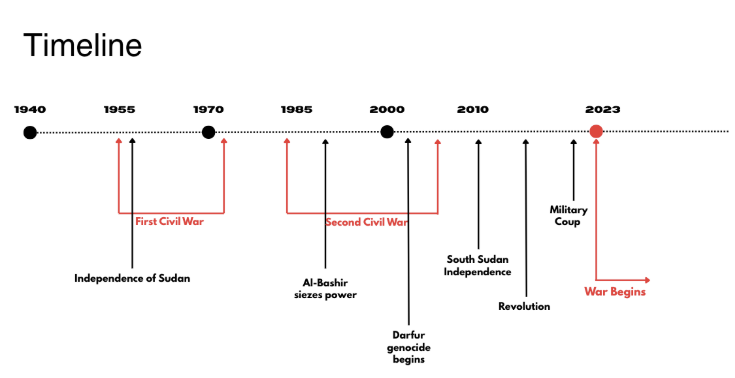
Author's own timeline
Sudan’s Third Civil War - RSF vs. SAF
Despite Hemedti and al–Burhan being on the same council, they soon began voicing opposing opinions regarding the direction the country should move in. After only eighteen months of working together, on April 15th, 2023, the two sides–Hemedti with the RSF and al-Burhan with the SAF–began shooting at one another. Though there are various claims with respect to who began the shooting, the fighting escalated quickly, and the third civil war in Sudan commenced.
On the morning of, heavy gunfire and explosions were heard throughout the city’s capital, Khartoum. Families had to run immediately, with only the clothes that clung to their backs and a few supplies at hand. Rawda Adam, a mother residing in Maamoura, Khartoum, clutched her daughter as they ran through the city, gunfire blazing around them. “We jumped over dead bodies as we fled the war,” she recalls. “I had to embrace my daughter so she wouldn’t see the horrors of the fighting.” Now, they both live with 200 other families in a shelter, which was once a school, as they face the burden of water and food shortages, as well as unbelievable heat.

More than 14 million individuals have been displaced since the war began, of which 4.5 million have fled to neighbouring countries. While Chad and South Sudan have welcomed refugees, both they and Sudan itself do not have the resources necessary to meet the demand of those needing humanitarian aid. This is an extremely critical crisis. Rawda Adam. Photo: IOM 2024/Fedza Lukovac
Additionally, it’s important to note that the RSF, headed by Hemedti, was formed in 2013 and can be traced back to the Janjaweed militia mentioned above, who brutally fought against the black African, non-Arab rebels and the general population. Not only this, but Hemedti has also been accused of intervening in conflicts in both Yemen and Libya, as well as smuggling metal into the United Arab Emirates (UAE). Due to these arrangements, the army accuses both the UAE and Libya of supporting the RSF by providing them with weapons and fighters.
Furthermore, due to the conflict, various parts of Sudan are controlled by either the RSF or the SAF. Here is a breakdown of who controls which area so far, as of March 2026.

Where We Are Now
Both groups are competing in a power struggle, shooting and terrorizing one another and the Sudanese civilians to legitimize their authority. However, this war is leaving millions across the country completely vulnerable to violence, displacement, and starvation. More than 70% of Sudan’s health facilities are closed or inoperable, there is a severe lack of basic resources like water and hygiene, the rates of malnutrition are extremely high, and eighteen million people in the country are facing severe levels of food insecurity.
Additionally, many organizations are questioning whether the RSF is engaging in another ethnic cleansing, aimed at making the region an Arab-dominated area. Moreover, the UN’s children’s agency, UNICEF, provided appalling evidence of armed men from the RSF raping and sexually assaulting children as young as one.
This is where I need you to please pause and reflect. Armed men are raping one-year-olds.
This is their weapon of violence. Their weapon of war. It is despicable and truly unimaginable. How have we let this happen? Where is the world’s voice and outrage when men are permitted to perform such acts of violence without any consequences? Why is nobody intervening so that this cannot happen again?
We need action. We need voices. We need people to take a stand against this war, not only because it is causing insufferable conditions for those living there, but because these men–both the SAF and RSF–are committing atrocious crimes against humanity. The UN has named this the “worst humanitarian crisis” in the world.
If you are not in a position of power to make change, spread awareness. Donate. Sign petitions. Tell your family. Tell your school. Where has our decency gone? You may believe you as a person are incapable of making any change or doing anything positive, but there is always more you can do. Attend more information nights, host debates, raise funds, and write papers.
Ignorance is easier. And a lot of people will choose to be ignorant. But if that’s the option you are choosing, it might be time to reconsider who you are as a person.
People are suffering, not only in Sudan but in all corners of the world. If not for Sudan, do something that helps the people in your city. Strive to make a change, even if only by the smallest mark. This era of cognitive dissonance, where we believe in something but act in a completely different way, must end. Small acts are still acts of defiance – acts of change. Update yourself on what is going on around you and begin to do better, bit by bit. If that means donating a bit more, giving up fast fashion, eating less meat, spreading awareness, all of these things, if we do it collectively, can transform societies.
We can do better. We must do better.
Petitions
Donation sites


Comments