


Tug of War: The Case of the Strait of Hormuz

Numerous places are not only charted on maps but also serve as geopolitical hotspots in the markets, among them: the Strait of Hormuz. This narrow maritime passage has had a recent, significant influence on multiple economies, following the American and Israeli strikes against Iran and the regional reprisals that ensued. This narrow strip of water is more than just a logistical corridor; it is the artery of global liquid oil consumption.
Where is this strait located? Why is it used? Who uses it? To discuss the Strait of Hormuz is to take a geographical and strategic look at the fragility of a globalised energy system and the point at which this system is subject to the political balances of a region.
Where Maps Meet Power (Where?)
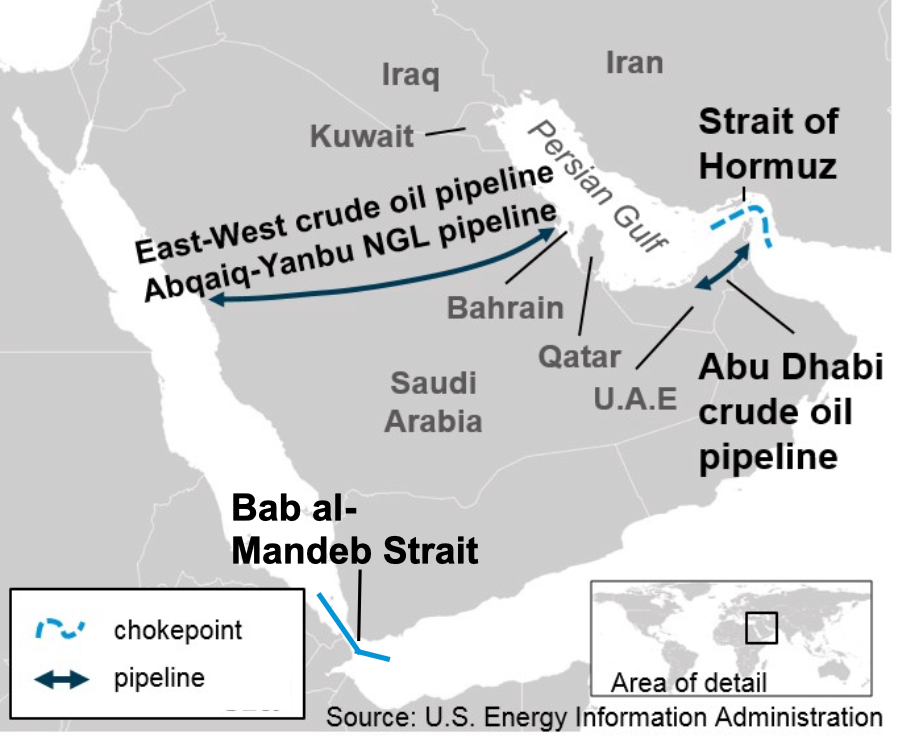
To appreciate the significance of the Strait of Hormuz, it is necessary to situate it geographically: a maritime passage located between Iran (north) and the Sultanate of Oman (south). It connects the Persian Gulf to the Gulf of Oman, a privileged geo-strategic position that is unique for the Gulf States wishing to export their hydrocarbons to other economies. The navigable space of the strait is very limited, with corridors only about 3 kilometers wide in each direction. It is this geographical configuration that has made the Strait of Hormuz a real ‘chokepoint.’
Its strategic location reinforces its strategic centrality, as it lies at the heart of one of the world's largest hydrocarbon reserves. The concentration of a number of resources around the Strait of Hormuz creates constant tension between the users of the maritime chokepoint. It is important to note that the strait has never been completely closed, not even during the long years of war between Iraq and Iran (1980–1988). This proves that despite violent clashes, the Strait of Hormuz remains open because of its vital importance, even when threatened.
Where Players Enter the Narrow Game of Hormuz (Who?)
The Strait of Hormuz is primarily used to transport hydrocarbons, oil and liquefied natural gas (LNG). Every day, around 20 million barrels of crude oil pass through the strait, representing nearly 20% of global liquid oil consumption. At the same time, nearly a fifth of the world's LNG trade passes through Hormuz, largely from Qatar.
The most important regional exporters include Saudi Arabia, Kuwait, Qatar, Bahrain and the United Arab Emirates, as well as Iraq. These powers are entirely dependent on this passage to transport their oil and gas to the rest of the world. Taking Saudi Arabia as an example, Saudi production amounts to several million barrels per day, and any potential incident in Hormuz could, unfortunately, force Riyadh to activate its strategic reserves or change its flows in order to avoid major disruptions.
Iran is a key user with reserves of 170 billion barrels of oil and the second-largest natural gas field in the world. Iran exports nearly 1.6 million barrels per day, most of which goes to China.
In regards to other importing countries, which are key players in the energy trade, are considered China, South Korea and Japan, which alone account for nearly 84% of crude oil and 83% of LNG transiting through the Strait.
Where Missiles Encounter Markets (What?)
As you may have seen, the beginning of 2026 has been marked by one of the most critical geopolitical crises, with a joint military operation by the United States and Israel against Iran. The first strikes were launched on 28 February 2026, and Iran immediately retaliated with missile strikes across the Middle East. These reprisals had a direct impact on the Strait of Hormuz, with commercial traffic in the strait coming to a virtual standstill. Iran announced that no ships would be allowed to pass through the Strait of Hormuz, while the Revolutionary Guards sent repeated messages to ships attempting to enter. The strikes had a significant impact, transforming this geo-strategic location into a high-risk maritime area, even though Iran did not describe it as a complete blockade. The repercussions of this ban on passage, with traffic almost completely suspended, meant that nearly 150 tankers loaded with crude oil, LNG or other cargoes had to drop anchor in the open sea.
The consequences were felt on global energy prices, with Brent crude reaching nearly $80 per barrel on 2 March, recording its sharpest rise in four years, an increase of 10%. European gas was also impacted, with prices rising by more than 50% on the Dutch TTF after production in Qatar was halted following attacks on the Ras Laffan and Messaieed facilities. Two vessels were also attacked showing even more signs of escalation through the Strait of Hormuz.
Some players, such as Saudi Arabia and the United Arab Emirates, have accelerated their exports in order to replenish their customers' reserves, enabling them to cushion the impact on the markets. However, fears of a rapid rise in transport and insurance costs of up to nearly 50% have exacerbated the crisis.
The current situation remains unstable with numerous challenges still ahead. Asian importers are watching these tensions closely, the Gulf oil monarchies are seeking to maintain their export flows and limit the damage, and Iran is threatening to block passage and de facto damage its trade relations with major importers.
This crisis relays the fact that the Strait of Hormuz is more than just a strategic point on our maps; it is a geopolitical and economic location where the slightest security tension has an immediate impact on prices and energy. Recent events have reminded us that this strip of water, just a few kilometres wide, is a vital artery in the global energy economy.


Comments