


Exploring Het Werkgebouw - FASHIONCLASH 2025
On November 14th, we had the opportunity to participate in one of the events as part of the FASHIONCLASH festival. The event was labelled as a Design workshop and Open Ateliers. It was portrayed as a chance to explore the works of several entrepreneurs and to see their creative process firsthand, in all its raw reality. Away from the busy streets, Designshop and Open Ateliers took place in a more suburban and industrial part of the city, adding to the events’ intimate and engaging nature. Open Ateliers was held in the building of a former garage in Maastricht. This location gave the collective an opportunity to host and accept more artists due to its large area.
Once we entered, we were immediately taken by the building's open-plan design. Most of the interior design was made from recycled hardwood planks from the Port of Rotterdam, illuminated by strong natural light coming from the window-like ceiling. Some of the collective artists' works were displayed throughout the space, hanging from the ceiling, truly capturing the playful atmosphere of the ateliers. It was hard to believe that the mentioned building used to be a garage and could be represented as an artistic piece of its own. Through our exploration of the event to better and fully capture the art presented, we interviewed seven artists. The questions asked ranged from the inspiration for their work to the processes and thoughts behind it. In the end, we were left with a strong sense of community in Het Werkgebouw as a working space for these artists, as well as visual proof of talented handmade creations and installations.

The first artist we talked to was a Belgian jewellery designer with Croatian roots, Kristy Bujanić. After graduating in fine arts, she opened her own studio at home. Because of COVID, she joined the ateliers and has already been there for three years. She draws her inspiration for making jewellery from looking back on some childhood memories, reminiscing on the emotions and feelings they bring out. Most of her jewellery is made from metal or materials often used before. The jewellery design is simple yet eye-catching, with an exciting, intriguing element, such as a knot made from a metal chain or a puzzle-like necklace made from recycled materials. The current collection she is working on is, in fact, her favourite, portraying both happy and elegant characteristics, allowing her to dive deep into her past experiences, whatever they may be. While designing jewellery, she feels as though she is reinventing herself, even while making mistakes, which she pushes through to discover a new purpose or path. Her Croatian roots also influence and inspire her work, such as the necklaces made as a tribute to the metal fence surrounding her grandparents’ home in Croatia. It was inspiring to see how emotions and memories build upon the artists’ already skilful talents, creating something very unique.
Making our way through the ateliers, we stumbled upon Loet Gescher, a Dutch jewellery maker and product designer. In her work, she likes to use unique materials, oftentimes those that are thrown away, giving them a new life and purpose. Every creation is labelled as her favourite, as she enjoys doing what she does and finds it an enriching and wonderful experience. Ever since she can remember, she has had her own workspace and indulged in creative projects. In her workspace, wonderful creations can be seen made from everyday objects that are not usually considered usable in an artistic way. Yet, Loet has found her special style and way of using those materials, such as the multiple bags seen in her workspace, created from the advertisement paper. While coming up with new ideas for her creations, she likes to work in silence, focusing completely on the creative process. Once she knows what she wants to make, she likes to listen to podcasts.

The next artist we interviewed caught our attention due to the bright colours and designs used in her creations. Etolie, originally from the UK, makes custom bicycles completely from scratch. We had the opportunity to see two of her works that were recently in an exhibition in Dresden, one of which was made as a present for her wife. Her work is inspired by her love for nature and adventure, alluding to the feeling of autonomy that manifests while riding bikes. Biking trips through Europe have also been a great inspiration for her while coming up with new ideas and creations. As a favourite creation, Etolie mentioned one of the bikes that was in the already mentioned exhibition. It is described as “cute and silly,” referring to its lively colours and small structure as the purpose of a city bike. Similar to many of the other artists we interviewed, she enjoys working in the ateliers and being surrounded by other artists, each with different techniques and working with different materials.

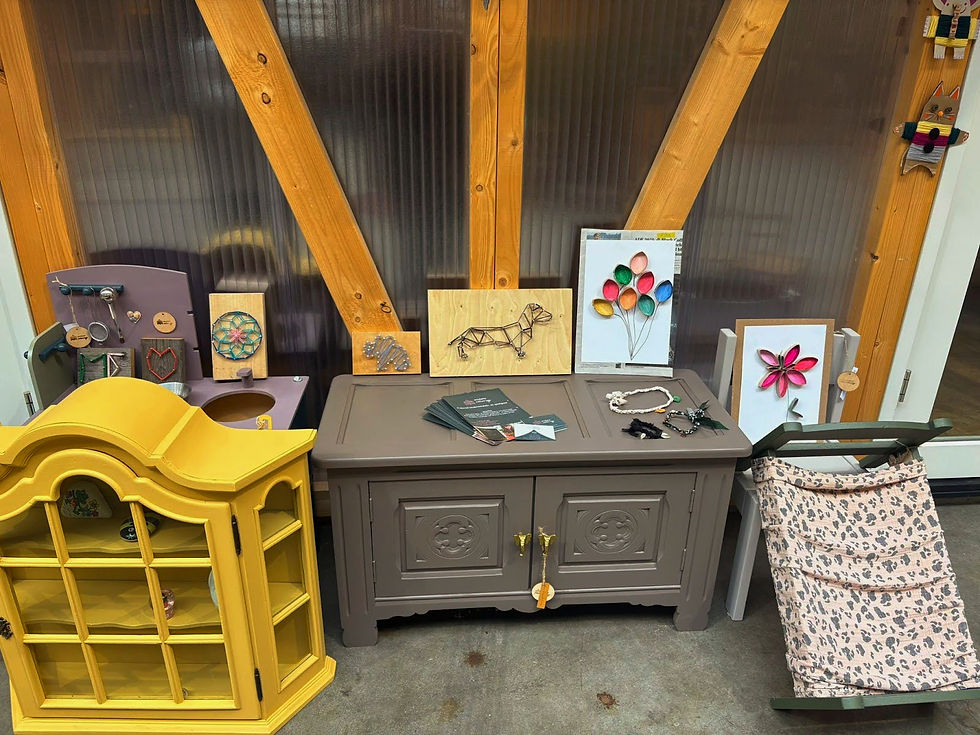
Shortly afterwards, we spoke with Simone Hensen. Simone Hensen, also known as “Madame Entourage” on her social media, restyles children’s furniture and wooden toys. She says that parents want the best for their kids, but may have to get second-hand products to do so. However, by restyling these products, she brings them back to the best quality and makes them even more enjoyable for the kids. Inspired by her grandad, who was a furniture maker, she had always had an interest in this field. Moreover, as a parent herself, she believes parents need to solve the problem of waste regarding children’s toys. Toys do not need to be thrown away hastily when old or not in use. Instead, they can be restyled and used again. Her favourite part of her process is when everything comes together. With the completion of the process, a spectacular product is made, which would bring smiles to the faces of kids and their parents. Wanting to share this gift, she also hosts children’s workshops in which she teaches simple crafts.
Following our interview with Simone, we met Dieter Lievens. Dieter Lievens is a 52-year-old artist who makes stained glass. He makes windows with coloured glass like those displayed in churches. He also does repairs and makes new stained glass for chapels, churches, people’s homes and art galleries. He was motivated to be in this profession because he loves to work with his hands and eyes, and he has been fascinated by color glass and the way the sun shines through it. For over 30 years, he has lovingly continued to make stained glass. His favourite creation is the stained-glass windows from the cemetery in Maastricht, and his current work on a stained-glass depicting science fiction about the universe, which he is deeply immersed in, is already showing fantastic results.
After our interview with Dieter Lievens, we spoke to Davina Versteeg, the founder of Solmode, a sustainable fashion design shop. Davina Versteeg is a sustainable fashion designer and has had her label since 2007. Davine is inspired by printing with nature and finds it very fulfilling. She was also inspired to work in this field since her grandmother taught her how to sew at eight years old. Since then, she has been fascinated by fabrics and loves to refine materials. To her, her work is more than a profession or a means to make money: it is about being creative. It saved her life, and she would never change it for any day. Her work is a way for her to be in the moment, and that’s why she loves it, as she expresses the importance of living in the moment, aiming to do just that in her life.

Natascha Waeyen is another artist we had the privilege to interview. She has been an artist for 30 years, beginning her journey at an art academy in Maastricht. At her workspace in Het Werkgebouw, she draws portraits, but in a non-conventional way. Natascha Waeyen draws using many lines, and those drawings form the basis of her pieces that mostly include three-dimensional art. Over the years, she has done various exhibitions, displaying her works in wire art installations. Some of her works are so large that a person could walk through them! She enjoys having little pieces of her drawings on the walls or sculptures of drawings displayed. Her work is also quite sustainable and can be recycled as materials, where old projects can be used to make new ones. Her works feature certain principles she holds, such as transparency, which she loves because “you can see the whole world still. Her favourite work is a 3-by-9-meter piece she created for the Millennial Project. The piece is called moNUment, which she made entirely with dots. Using the dots created by the wire, she created a code for all the years, from year 1(001) to year 2000. The code created was printed into the organ book, and the organ makes the sound from the numbers!
The time we spent with the artist was truly a worthwhile experience, and we were enlightened on the different ways art can be made and the inspiration behind them. It was definitely a time to remember.


Comments