


A Real Place To Stay!
The team of Place to Stay did a great job in transforming Griendgarage - the industrial space - into a comfy and welcoming movie room. From the cozy sofas and carpets to the hot chocolate and mulled wine stand, one could notice that the organizers put a lot of thought and intention into the details. All combined, they managed to create a pleasantly silent and respectful atmosphere, turning the grey hangar into a true place to stay!

Over twenty short films were projected on the big wall. The team of Place to Stay had the fun idea to ask a band to play live over the films. Phukh, one of the musicians, explained to us that this was all improvisation-based, which is impressive, considering each musician having to weave a melody as they discovered the images. The team received over fifty short film applications, and managed to select a panel of films of various themes, lengths, and techniques – from black and white images to animation with knitted puppets.
One movie that particularly stood out was “One Day I’ll Be Rich” by Lucas Camps, a movie with talented really young actors playing the encounter of two kids from different social classes on a camping holiday. As the young boy sits in his camping chair being a little bored, a very modern camper van pulls up. A young girl steps out and says hi. At first he’s a little insecure and intimidated. The filmmaker plays with the divide of class. But the viewer encounters a beautiful story in which there's no barrier. Everyone in the audience had a smile on their face while they watched the two characters make up an imaginary world together. It was emotionally touching and reminiscent of one’s childhood.

The short film “Interesting Things” demonstrated the variety of films that were shown. The filmmaker discovers Palestinian archives before the Nakba. She looks at Frank Scholten’s images stored in the archives of the EU. The filmmaker points out that since she’s a White European woman she’s biased when looking at these photographs. As she’s surprised at first to see a picture of a Levant (car), quite common in the 1920s, her stereotypical assumptions and lack of knowledge become clear. A car in Palestine at that time was not what she expected. This proves her point that it does matter who looks at these photographs, but also that to not look at them would be a mistake. It challenges Western knowledge portrayed through media and collective memory. Whose gazes are preserved? What exactly is the colonial context in which these images were taken? What did the photographer know, in comparison with what we know now? This film provokes rethinking of one’s historical knowledge, images and symbols of Palestine that we have, and where this knowledge comes from.
Talking with film-makers
After the festival, we had the opportunity to discuss with two film-makers: King Kose and Hidde Hamming. King Kose directed the short movie “Growing Down”, which he described as a “music video, a fashion film”, where he features the collection of designer Maria Ribes Sola. With its characters dressed in whimsical, colourful outfits, it reminded us of the Mad Hatter. Transported by the swirling movements of the camera, the audience really liked the film. Kose wanted to draw attention to the fashion scene and how fascinating fashion can be. He explains: “her art is about inner child, tapping back into yourself… so for the fashion film I flipped the whole script, it’s very adult-themed, so there’s smoking, kissing for a very long time… until you think, ‘Oh damn, they’re still kissing’”.
Hidde Hamming is a student in photography in Maastricht. He made the short film “De Kreuking”, a film about “an artist who gets really obsessed to the point where the artwork itself takes grip over him, and the relationship with his girlfriend in this context”. But fundamentally, this film is about how getting lost in art, to the point where everything is black and white (as the images). When the film was finished, I told my friend right away: ‘this made me uncomfortable’ – the actor’s facial expressions, his body movements, and the black-and-white images honestly made me feel weird. While at first I did not want to share this with Hidde because I was scared to offend him, he surprised me when he said: “I really try to play with the uncomfortableness that you can have when watching a film… you know, that feeling when you don’t wanna watch something but you keep looking”. This is what makes this film so interesting! Hidde tries to play with you when you watch, and to shake and reverse your expectations of a short film.
One short but important point that both of the film makers raised was feeling a bit unsatisfied with the live band. King Kose explains: “Everyone's film was not a theatrical horror movie, but the music made it sound like it was one… it excluded how important audio is for film-makers.” Hidde Hamming also shared that the live band “takes away from the original message, because you’re missing beats and auditory elements that convey certain messages”. They however nuance their point later on: “I really like the idea of the live band tho, I’m all in for trying out new stuff, but I feel like the band could have listened to the original audio before to make it sound better”.

Talking with the audience
The audience was very enthusiastic about the event. Recurring sentiment among goers was a pleasant surprise when they discovered the make-up and hot drinks stand. Opinions on favorite films varied widely and some of them were indeed critical about the live band, such as Sofia, who shared: "I would like to hear a bit more what the original soundtrack would sound like”. But one thing people all agreed on was the diverse selection of films.
A number of viewers were also very appreciative of the donation-based nature of the event. Anna, who I spoke with outside, explains: “I enjoy seeing the Griendgarage being used for more events, because people usually know it as a skate park… and it’s cool that it’s donation-based, because I read on their instagram that their sponsor pulled out… we have that responsibility to keep such cultural places going”. Fortunately, the hosts of Griendgarage are looking forward to hosting more events for the community, from the community.
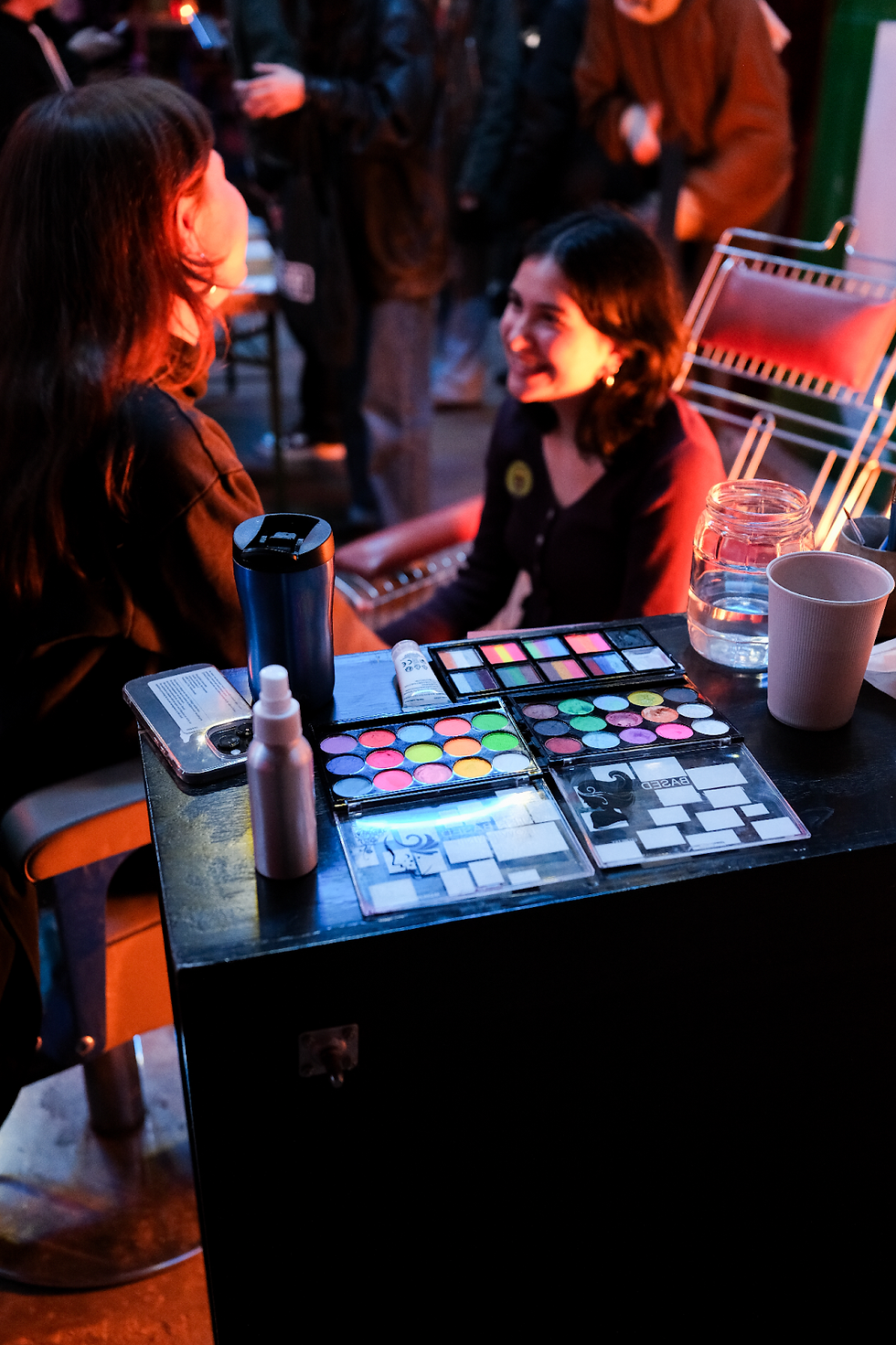
Gianna, a visitor, stated how the collaboration with “Place to Stay” scored an open, low-threshold and safe space for the community in Maastricht and beyond while supporting families that are in need of a place to stay. An event like this will certainly not solve the issue of displacement but it can inspire others to take initiative to raise awareness, organize fundraising and reflect on privilege. In what way can I contribute? What is my place in all this?
Mia, one of the organizers, admits that it's a dynamic process that requires time and dedication. Luckily they were allowed to transform the place as they wished. The freedom and flexibility they were given surely added to the team’s success. To support each other and share a collective goal that’s bigger than themselves, allowed them to host the film festival and future events.
This event was a great experience for both of us, we learned a lot about moviemaking, and the young artistic scene in Maastricht and its audience. Thanks to the teams of Place to Stay and Griend Garage, and to the artists!


Comments